
Time, the Master Ingredient
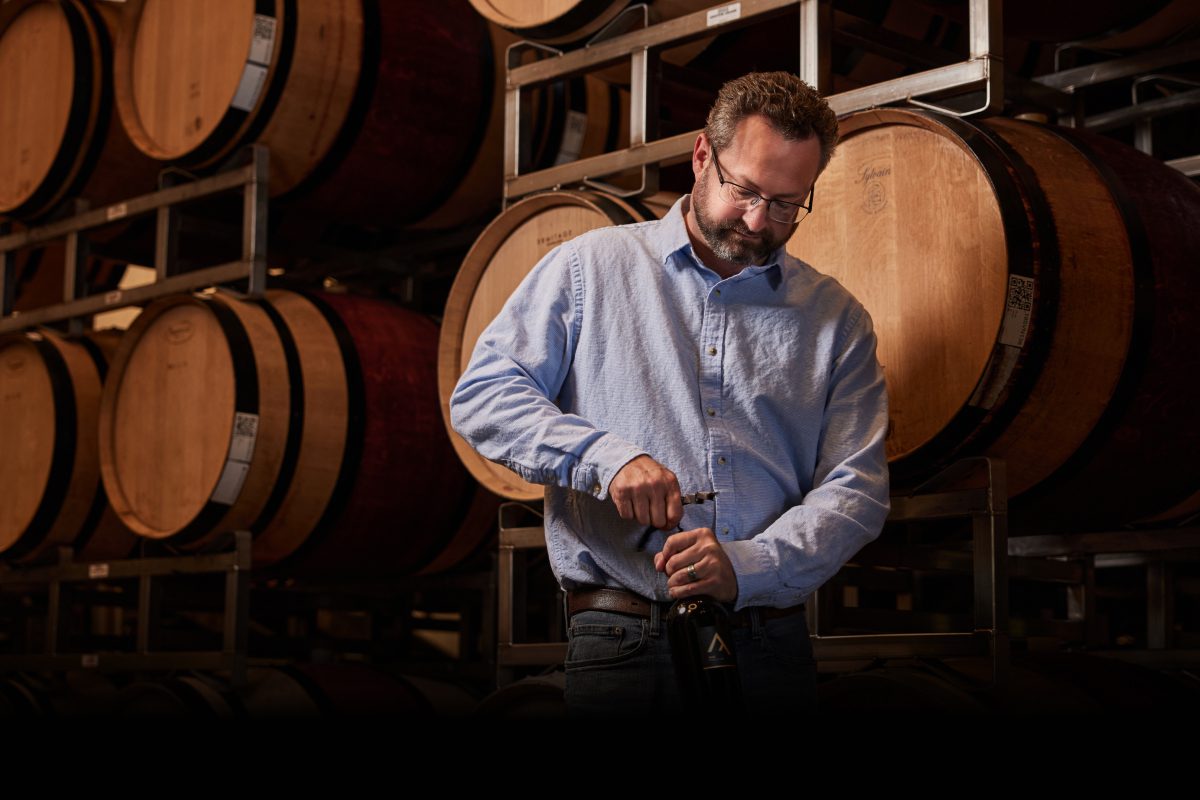
Almost everything humankind makes is built to fade. Steel oxidizes, paint dulls, and the finest leather cracks and thins. Entropy is the house rule, and the house always wins, but wine is the rare exception. Given the right hands and the right ground, time does not diminish a great bottle. It comprises one. Time is not what a wine survives. It is what wine is made of.
That single idea explains a great deal about why Seven Apart works the way it does, and why a glass of estate Cabernet rewards attention that most products never ask for. To understand a Seven Apart wine is to understand that you are holding a kind of time capsule, one that never quite stops working: in the bottle, in the decanter, and in the glass, right down to the last sip.
The mechanism inside the capsule
Ask winemaker Morgan Maurèze what carries a wine across the years, and the answer is unglamorous and exact: tannin. Over time, the tannins and color compounds slowly link together and settle out, which is most of what you find as sediment in an older bottle. As they do, the wine softens. The edges round. The intensity that once announced itself begins to murmur instead.
“When I’m crafting a wine, I’m crafting it for twenty to thirty years down the road, so I know it’ll still be delivering texture and color,” Maurèze says. He compares it to an ultramarathon rather than a sprint. A wine has to come out of the gate with something to say, then keep saying it for a generation. That balance is a question of tannin management, decided long before the bottle is sealed, and it is the subtle machinery that lets a wine move through time without falling apart.
This is also where Seven Apart’s high mountain fruit earns its reputation. Conventional wisdom says elevation gives you tight, green, aggressive tannins that need years just to become drinkable. The estate’s site delivers something less expected: tannins that are intense and structured yet soft, rich without turning bitter. The wines are approachable the day they are released, and they are built to reward patience for decades. Both ends of the same bottle.
The first arc happens in the glass
Long before you reach the question of years, time is already at work in front of you. Open a young wine, and note that you are not drinking one thing. You are drinking a sequence.
Maurèze keeps a deliberate ritual when he writes tasting notes. He opens the bottle, records his impressions in the first fifteen minutes, then returns roughly forty-five minutes to an hour later to capture the aromas that have arrived in the interval. The notes that result span the life of the bottle, from the first pour to the last glass. Most people, he points out, finish a bottle within about an hour of opening it, which means the wine in the final glass is meaningfully different from the wine in the first.
Decanting is simply a way of conducting that arc on purpose. For younger wines, the estate’s sweet spot is around an hour of air, which lets the aromatics open and find their fullest expression. The instinct does have limits. Truly old wines, the bottles from the 1970s and earlier, are best left undecanted, their fragility respected rather than rushed. And there is a familiar regret that proves the point: the wine that finally shows beautifully at the end of the evening, just as the last sip disappears, that is the one that makes you wish you had given it that hour from the start.
Even the vessel bends the experience. Larger glasses gather and hold more of a wine’s aromas; smaller ones surrender them. Maurèze has poured the same wine into two different glasses and watched it smell like two different wines. None of this is fussiness. It is the recognition that a wine is a moving target, and the glass is part of how you aim.
The longer scales, and the bridge across them
Stretch the timeline and the same principle holds at every distance. A bottle that has traveled wants days or weeks to rest and settle before it shows its best. Across months and years, maturation does its slow polishing in the dark. And across decades, something happens that no technique can shortcut.
“Only time can create that, and nothing else,” Maurèze says of the character older wines develop. It is why a serious cellar is, in a sense, an exercise in patience as a discipline. A wine laid down years ago is a bridge between who you were when you stored it and who you are when you finally open it, between the world as it was and the world as it has become. The palate tends to travel toward this appreciation rather than starting there. As a drinker tastes more widely, the nuances of age stop reading as strange and start reading as beautiful.
Worth saying plainly: this is a preference, not a prescription. Some collectors will always love the bold tannins and bright energy of a young vintage, and a Seven Apart wine is made to satisfy them on release. The point is not that older is better. The point is that wine, almost alone among the things we buy, gives you the choice at all.
The hour, the light, the place
Time of day shapes the wine as surely as the years do. Maurèze prefers to blend in the late morning, before lunch, when hunger sharpens the senses and the nose works at its best. It is a useful clue for the rest of us. The grand bottle saved for evening deserves a lighter lunch and an unhurried day, so that anticipation can build and the palate arrives awake rather than dulled.
Setting carries its own weight. A wine can make a meal, and the wrong mood or moment can undo a great one. Light matters too, which is why fine wine is stored in the dark; you taste with your eyes first, and the color you see begins shaping the flavor you expect before the glass reaches your lips.
All of which leads, gently, up the mountain. High above the fog line, on the Stags Ridge vineyard, the estate keeps its own clock. The cool of early evening is when the site reveals itself, when the vines lift again after the heat of the day and the light turns long and gold over the valley below. It is the hour when place and time stop being separate ideas and become a single sensation. Napa, at its peak.
It is also the thinking behind The House at Stags Ridge. Restored across a year and a half and reserved for the estate’s closest members, the House sits near the summit, the vineyard climbing to its door and Atlas Peak filling the view beyond. There is no tasting counter and no crowd, only the land and the wine it produced, a few steps apart. It was built for the unhurried hour this journal describes: to arrive with the day behind you, to let a bottle open at its own pace, and to taste a wine in the exact place its fruit was grown, at the time of day that flatters both. From the land to the glass, with nothing in between.
A great bottle is a standing invitation: to choose the moment, to make room for it, and to let time finish the work it began years ago. Pour it an hour early. Reach for the better glass. Some wines are worth the drive to the top of the mountain. Every one of them is worth arriving on time.