
The House at Stags Ridge: Above the Fog Line
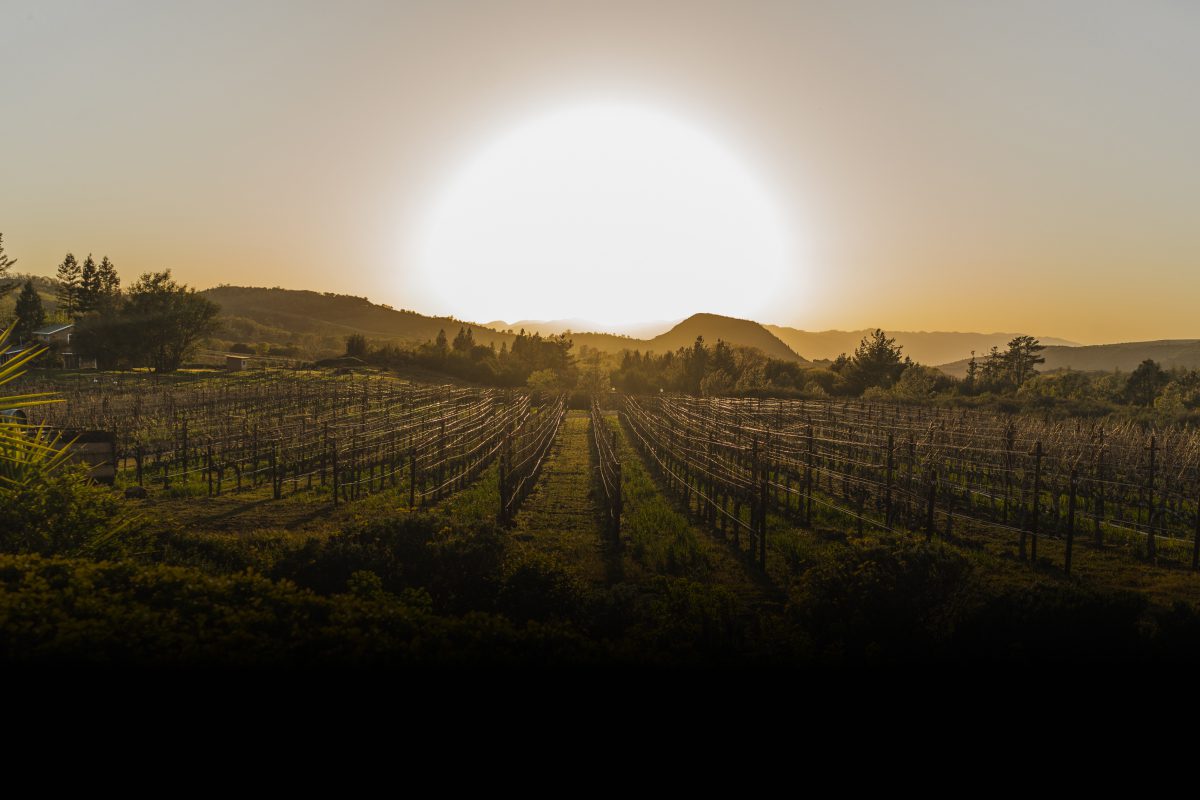
Our Stags Ridge vineyard sits 1,475 feet above the Napa Valley floor, on the eastern shoulder of Atlas Peak. For most of the people who acquire our wines, the bottle is as close as they have ever come to the ground that produced them. After nearly two years of construction, that is about to change.
The House at Stags Ridge is nearly finished. When it opens, it will allow us, for the first time in the estate’s history, to receive guests at the Stags Ridge vineyard itself.
A Place That Does Not Feel Like Napa
Most visitors to Napa stay on the valley floor. The wineries are there, and so is the experience that has come to define the region. Seven Apart’s Stags Ridge sits above all of that. To reach it, you must climb out of the valley and onto the eastern face of Atlas Peak, where the paved road gives way to a third of a mile of dirt, cut directly through the vineyard. By the time the road ends at the house, the valley feels like another country.
The terrain rewards the climb. On most mornings between May and October, the coastal fog rolls into Napa heavy enough to feel like weather, settling low across the valley until mid-morning. Stags Ridge sits above it. “You drive through what feels like rain,” explains Managing Partner Yannick Girardo. “And then somewhere past a thousand feet, the windshield clears. The sun is already up. The fog is below you. People who haven’t seen it tend not to forget it.”
A House Built for the Vineyard
The structure at the top of the property has stood there for years, set back from the rows with the back of the house facing east toward Atlas Peak. For the past twenty-four months, it has been remade. What emerges is intimate by design. The House will receive up to six guests at a time, built around the experience of the vineyard rather than the building. The view does the work the architecture knows better than to interrupt.
This is not a hotel, nor is it a tasting room. It is a private home, opened occasionally, to a small number of Seven Apart members. Capacity is quite limited by design.
From the Land to the Glass
A visit to The House at Stags Ridge begins at Base Camp, where guests meet our team and are driven up the mountain. The road is one we prefer to navigate ourselves; it defies GPS directions and requires careful navigation. For our guests, being driven frees the day from the demands of the steering wheel and lets the climb itself become the beginning of the visit.
From the back deck, the view sits directly across at Atlas Peak. The Basalt and Shale blocks of the vineyard are within a short walk, and a guided exploration of the two soils makes the geology of these wines legible in a way no other experience can. The same clones grow at the same elevation under the same weather. The wines are nonetheless distinct because the rock beneath the vines is different, embodying such strong contrasts.
From there, the visit becomes what the day calls for. The House has a full kitchen, and a meal is on the table when appropriate. A longer afternoon of walking the parcels, or a breathtaking sunset view with the Atlas Peak wines opened slowly across the hours is just as welcome. “At The House, we are inviting friends to the property rather than hosting guests at a winery,” Yannick notes. “The experience can be curated to whatever the day asks of us.”
It is, by his own admission, a place most guests will not want to leave.
The Next Step in the Estate’s Evolution
Seven Apart has, since its founding, been built around seven elements that set the estate apart. The first four belong to Stags Ridge: the terroir, the elevation, the topography, and the vineyard layout. The remaining three live at Base Camp, where the production facility, the hospitality team, and our winemaker complete the work.
For most of our history, the experience of Seven Apart has been shaped by the three at Base Camp. The House at Stags Ridge does not replace that work, it extends it. For the first time, the four elements at the top of the mountain can be experienced where they live, on the ground that produces the wines and the region that surrounds it. The estate has been building toward this for years. It is not a destination; it is the next step for the growth of Seven Apart.
By Invitation
The House at Stags Ridge will not appear on our reservation bookings page. The calendar is small, and the capacity is smaller still.
Those who would like to know more are welcome to contact Yannick Girardo directly.
The Room Gets Smaller. The Wine Gets Better.

There is a version of wine tasting that most people know.
You pull into a parking lot. You walk into a large, beautiful room. Someone pours you five wines, reads from a card, and smiles warmly while you decide what to buy before the next group arrives. It’s pleasant. It’s scenic. And by the time you get to the third winery of the day, every tasting starts to blend into the one before it.
This is not a criticism. Many wineries do this well, and the hospitality is genuine. But there is a reason that experience starts to blur, and it has less to do with the wine than with the conditions surrounding it.
When the room is large, the attention is divided. When the pace is brisk, the conversation stays surface. When forty or fifty people move through a tasting room in an afternoon, the wine becomes a product on a counter rather than a story being told between people who are paying attention to each other.
The wine does not change. But the experience of it does.
Why Being Together Matters
We live in a time when most of our interactions are mediated by screens, schedules, and the quiet pressure to be efficient with our hours.
We text instead of call. We scroll instead of sit. We are, by most measures, more connected than any generation in history, and yet loneliness research continues to suggest we are experiencing less of the kind of presence that grounds us.
Wine has always been a counterweight to this. Not because it is special or ceremonial, but because it is slow. It requires you to stop, to pour, to sit with someone and pay attention. A glass of wine in your hand is a gentle reminder that the rushing has paused, even if only for an hour.
This is not a new idea. It is one of the oldest ideas in human culture. Wine moved from temples to tables thousands of years ago precisely because it served this function: it brought people together around something shared, something sensory, something that rewarded patience and attention. The ritual was never exclusively about the wine. It was about what the wine made possible between people.
And that function, that grounding, is under more pressure now than it has been in generations.
The Case for Fewer People
If the purpose of wine is connection, then the conditions of how you experience it matter enormously.
Think about the meals that stay with you. Not the ones at the largest table, but the ones where the conversation went somewhere real. Where you said something you had been thinking about for a while. Where someone else did too. Where the food and the wine were not just good but noticed, because the pace was slow enough to notice.
Scale is the enemy of that experience.
This is something the fine dining world understood decades ago. The greatest restaurants in the world do not seat two hundred. They seat thirty, or forty, or twelve. Not because exclusivity is the point, but because intimacy is. Because the kitchen can only maintain a certain standard of care when it is cooking for a certain number of people. Because the conversation between the chef and the table requires proximity.
Wine, strangely, has been slower to absorb this lesson. The Napa Valley tasting room model was built for volume, and it works well for discovery and tourism. But for the person who already knows what they love, who has tasted widely, who is looking not for more wine but for a deeper relationship with the wine they choose to collect, the large format starts to work against itself.
The wine deserves better conditions than that. And so do you.
What We Do Differently
At Seven Apart, a tasting is not a rotation. It is a conversation.
We host two, sometimes three, tastings a day. Groups are small, typically between two and eight people. The gate stays closed until you arrive by appointment. There is no walk-in traffic, no bus tours, no ambient crowd noise competing with the wine in your glass.
This is by design.
When the group is small, the host can pay attention to what you are responding to. The conversation can follow where your curiosity leads rather than adhering to a script. If you want to understand why the Basalt and the Shale taste so different despite growing on the same vineyard at the same elevation, there is time and space to explore that. If you want to know what happened in a specific vintage, or why picking decisions shifted from one year to the next, that conversation can happen.
Our winemaker, Morgan, will sometimes sit down at a tasting and ask a question that surprises people: What have you always wanted to know about wine but felt afraid to ask? It is a disarming question. It acknowledges that wine culture can be intimidating, that the language around it can feel like a barrier, and that in a small room with the person who made what you are drinking, there is no wrong question.
That is not a scripted hospitality moment. It is what happens when the room is small enough for the people in it to be themselves.
A Journey, Not a Flight
The tasting at Seven Apart is structured as a journey through elevation.
It begins with wines from the valley floor, where the fruit is generous and the terroir expressive in a familiar, approachable way. Then it climbs. Through the mid-mountain wines, where the character begins to shift, the fruit tightens, the structure deepens. And then to the single-vineyard wines from the top of Atlas Peak, where the volcanic soils and the altitude produce something that most people do not expect from Napa Valley.
This is not a flight of five wines poured side by side. It is a guided experience of what elevation does to a grape, what soil composition does to flavor, and what farming at the edge of viability produces in the glass. You taste the difference between valley and mountain. Between ease and struggle. Between wines that are grown and wines that are earned.
Along the way, the education is woven in rather than delivered as a lecture. You see the soils. You understand why the berries at higher altitude are smaller, denser, more concentrated. You begin to draw your own connections between what you are tasting and why.
By the time you reach the final wine, you are not just drinking. You are understanding. And that understanding changes the way you experience every bottle of Seven Apart that you open after you leave.
The Memory You Take With You
There is a reason we believe wine should be collected and drunk, not stored as a trophy behind glass.
Every bottle carries a specific moment in time. The vintage. The weather. The picking decisions that were made that year and no other. When you open a bottle that you first tasted at the winery, you are not just experiencing the wine. You are returning to the afternoon when you first understood it. The people you were with. The conversation that happened over that glass. The light at that hour.
This is what wine does that almost nothing else can. It connects us across time. The first bottle creates the memory. The second bottle, opened years later, brings it back.
That transportive quality is not a marketing idea. It is something anyone who has opened an older bottle with someone they love already knows. And it is something that becomes far more powerful when the original experience was unhurried, intimate, and genuinely shared.
This is why the conditions of the tasting matter so much. Not because exclusivity is the goal, but because the memory you form here is the one you will carry into every future bottle.
An Invitation
We are not for everyone.
We produce under 2,000 cases a year. We farm at elevations that most producers avoid because the work is harder, the yields are lower, and the margin for error is thinner. We keep the gate closed because the experience we offer requires our full attention, and we cannot give that to fifty people at once.
But for the people who find us, who schedule the appointment, who drive up and walk in and sit down with a glass, something happens that is increasingly rare in the wine world. The pace drops. The noise falls away. The wine is poured by someone who knows the vine it came from and the vintage it grew in. And the conversation that follows is not about selling. It is about sharing something we are proud of with someone who is ready to receive it.
If that sounds like the kind of experience you have been looking for, we would love to welcome you.
The best winery experiences in Napa are not the ones that try to impress the most people. They are the ones that give the fewest people their full attention.
And that is what Seven Apart was built to do.
Born from Fire. Why Geology Isn’t the Next Frontier of Fine Wine. It’s the New One.
If you collect wine, you already speak the language of terroir.
You know that place matters. You understand that the same grape, grown in different soils, under different skies, becomes a different wine entirely. That knowledge is what separates the collector from the casual drinker.
But here is a question most collectors have never been asked: do you know what your terroir is made of?
Not the climate. Not the elevation. Not the exposition or the microclimate or the vintage variation. The rock itself. The geological event, millions of years old, that determined why that soil drains the way it does, holds heat the way it does, and starves a vine in exactly the right way.
Because terroir is a story. But geology is the origin of that story. And if you understand the rock, you understand the wine at a level most people never reach.
The Limestone Century
The 20th century built its wine hierarchy on one rock type above all others: limestone.
From the grand crus of Burgundy to the chalk cellars beneath Champagne, from the Kimmeridgian marls of Chablis to the calcareous slopes of Barolo, limestone has been the geological shorthand for world-class wine for generations. And for good reason. Limestone offers excellent drainage, moderate fertility, and a pH environment that many grape varieties thrive in. The French formalized this understanding centuries ago, and the global market followed.
Granite earned its own moment through the steep slopes of the Northern Rhone, parts of Beaujolais, and sections of the Douro. Granite soils gave the wine world a second geological vocabulary: mineral tension, floral lift, a certain transparency in the fruit.
But limestone and granite share something in common. They are both, geologically speaking, quiet. Limestone forms from the slow accumulation of calcium deposits on the floor of an ancient sea. Granite crystallizes deep underground over millions of years, cooling slowly, forming orderly structures. These are rocks born from patience.
There is another kind of rock entirely. One born from violence.
What Basalt Is
Basalt is not sedimentary or metamorphic. It is igneous, and is the product of volcanic eruption.
When lava reaches the earth’s surface and cools rapidly, it forms basalt: dense, fine-grained, dark, and rich in iron and magnesium. It does not build up over millennia like limestone. It arrives in a catastrophic event. It is rock forged by fire, shaped by force, and hardened by exposure.
Over time, basalt weathers into a particular kind of soil. One that drains well through its fractured structure but retains moisture in its deeper layers. One that is low in organic nutrients but high in minerals like iron, magnesium, and calcium. One that is notably more alkaline than most vineyard soils.
This combination creates something viticulturists have long recognized as the “Goldilocks zone” for premium grape growing. Not too fertile, not too barren. Not too wet, not too dry. The vine survives, but it does not thrive easily. It is forced to send roots deep. It produces smaller berries with thicker skins, concentrating the tannins, the color, and the compounds that give a wine its structure and aging potential.
Any serious collector already knows that vine stress correlates with quality. The grand crus of the world were identified long before we had the science to explain why, simply by watching which difficult sites produced the most extraordinary wines. What is less widely understood is how narrow that sweet spot is, and how specific the geology has to be to land inside it. Our winemaker Morgan puts it plainly: you can overstress a vine just as easily as you can understress one. The sites that produce the most compelling fruit are the ones where the geology itself creates the right tension, not too much, not too little, before the viticulturist ever intervenes.
The Mechanism: How Rock Becomes Wine
Wine science has an honest tension that many gloss over.
The word “minerality” gets used constantly, but the direct mechanism by which soil minerals translate into flavor perception has never been conclusively proven.
We will not pretend otherwise.
What has been proven, repeatedly and measurably, is the indirect effect: how soil composition governs drainage, nutrient availability, root depth, vine vigor, berry size, and skin-to-juice ratio. These are the physical pathways through which geology becomes flavor.
Basalt soils are particularly interesting because they influence the vine from multiple angles simultaneously:
Drainage and stress. Fractured basalt provides the rapid drainage that prevents waterlogging while retaining enough moisture in deeper layers to sustain the vine through dry periods. On mountain sites like Atlas Peak, where topsoil is thin and rock is abundant, this balance is critical. Without modern irrigation technology, these sites would have been nearly impossible to farm. A century ago, no one was running water lines up a mountain. The sites that produce our most compelling wines were, until very recently, beyond practical reach.
Thermal regulation. Dark basalt absorbs solar radiation during the day and releases it gradually as temperatures drop. On sites above the fog line, where sun exposure can be more intense than the valley floor, this thermal mass acts as a buffer. It softens the transition between Napa’s dramatic diurnal temperature swings, which can range from 90 degrees during the day to 50 degrees at night. The vine needs that cooling period to develop balanced acidity, and the basalt moderates the descent rather than allowing an abrupt crash.
Alkalinity and tannin. Basalt tends to push soil pH toward the alkaline end of the spectrum. This directly affects nutrient uptake in the vine, particularly iron and phosphorus, and appears to play a role in tannin expression. Wines grown on basalt soils at our Stags Ridge vineyard consistently show bigger structure and more pronounced tannins than their neighbors on different rock types. But here is what makes it fascinating: the naturally higher pH also softens those tannins, making them polished and approachable even when they are substantial. The terroir does the tannin management before the winemaker ever touches the fruit.
This is not a subtle effect. You can taste it.
The Collector’s Thesis
Here is where this becomes more than a geology lesson.
Collectors already know the feeling of finding quality before the market catches up. Geography has been the primary lens for that kind of discovery for most of the modern era. The right appellation. The right vineyard name. The right side of the hill.
But geology offers a different lens entirely. And basalt, specifically, represents a geological story that the fine wine market has not fully accounted for.
Consider why. The limestone regions had centuries of documentation and classification. Burgundy’s vineyard hierarchy dates to medieval monks. Champagne’s chalk cellars are literally carved into the rock that grows the grapes. Granite regions like the Northern Rhone benefited from a generation of critical champions who celebrated Hermitage and Cote-Rotie.
Basalt regions, by contrast, were historically too difficult and too expensive to farm at the level required for fine wine. The terrain is steep, rocky, and inhospitable. The yields are naturally low. The infrastructure required, particularly irrigation at elevation, simply did not exist until recent decades.
Which means basalt-grown wines are arriving at the market at the precise moment when viticulture and winemaking have reached a level of sophistication that can fully realize their potential. The rock has been there for millions of years. The ability to farm it with precision is measured in decades.
This is not speculative. It is already happening in pockets around the world: volcanic sites in Sicily, the Canary Islands, parts of Oregon, sections of the Azores. But nowhere in North America is the intersection of basalt geology, mountain altitude, and Cabernet Sauvignon more concentrated than on Atlas Peak.
A Wine Born from Catastrophe
When you drink a wine grown on basalt, you are drinking something shaped by an event that happened long before anything resembling a vine existed on this continent.
Millions of years of lava flows and tectonic upheaval, followed by the slow, grinding weathering of volcanic rock into the fractured, iron-rich soil that now feeds a root system fighting for every nutrient it can find.
Limestone is the geology of accumulation. Clay is the geology of stillness. Basalt is the geology of rupture and transformation. And the wines that come from it carry that character: structured, concentrated, built for time.
At Seven Apart, our Basalt is grown on exactly this kind of ground. The Stags Ridge vineyard sits at 1,475 feet on Atlas Peak, above the fog line, on fractured volcanic rock with almost no topsoil. The vines work for everything they produce. And what they produce has a depth, a grip, and a persistence that reflects the land in ways that continue to surprise even us.
We do not make this wine to prove a thesis about geology. We make it because the geology proved itself to us, vintage after vintage, in the glass. But if you are someone who collects with intention, who wants to understand not just what you are drinking but why it tastes the way it does, then we would suggest this: geology is where the new chapter of collectible wine is being written. And basalt is the page most people have not read yet.
The Pleasure of the Table: Why Wine Demands Presence

Wine is meant to invoke pleasure and emotion.
This is not a complicated philosophy. It does not require a sommelier certification to understand or a cellar full of first-growths to practice. It is simply true. Wine exists to bring pleasure, and the best wines do this by demanding something of us in return: our attention.
You can drink wine while scrolling through your phone. You can drink wine while half-watching something on television. You can drink wine while doing almost anything else. But when you do, you are not really drinking the wine. You are just consuming liquid. The pleasure stays locked in the bottle, unreleased.
The pleasure comes out when you stop everything else.
What a Napa Valley Wine Tasting Experience Can Be
Most Napa Valley wine tasting experiences follow a familiar script. You arrive at a beautiful property. Someone pours you several wines. You learn about the winery’s history, perhaps hear some tasting notes. You purchase a few bottles if they suit you, and you leave.
This is fine. There is nothing wrong with it. But it is also incomplete.
A tasting experience becomes something more when it stops being about the wine you are drinking and starts being about why the wine exists at all. When it moves from consumption to understanding. When the person across the bar is not just pouring wine but helping you discover something you did not know before.
At Seven Apart, we think of our tastings as a journey. Not metaphorically, but literally. We begin at the valley floor with wines like Base Camp and Expedition, where the fruit carries the complexity of mountain influence without the full intensity of peak elevation. These wines are invitations, entry points into what the land can do.
Then we climb.
Through the single vineyards of Atlas Peak, each wine reveals a different facet of a place most people have dismissed. Atlas Peak has never had the name recognition of Howell Mountain or Mount Veeder. Many in Napa assumed the fruit grown there would be too tannic, too hard, too unapproachable for ultra-premium wine. We believed otherwise. And we have spent years proving it.
The wines we pour tell that story. From the volcanic intensity of our Basalt to the refined suppleness of our Shale, you taste not just different grapes, but different expressions of the same commitment. Same sun. Same hands. Different earth. Each glass is a chapter in a longer narrative about what elevation, terroir, and patience can produce when you refuse to take the easy path.
The Philosophy Behind the Glass
Our winemaking philosophy is not complicated: get exceptional fruit, then stay out of its way.
The greatest wines and terroirs of the world share this discipline. You do not improve a great ingredient by over-manipulating it. You do not make a beautiful piece of fish better by drowning it in sauce. You honor what the land has given you by letting it speak.
This means we use oak the way a chef uses salt. Enough to season. Never enough to overwhelm. It means we pick at the moment when the vineyard is showing itself at its peak, not when some number on a refractometer tells us to. It means we accept that every vintage will be different, because every year the mountain gives us something new.
Some winemakers chase consistency. They want every bottle of every vintage to taste identical, a product you can rely on like a manufactured good. We find this strange. If you wanted something identical every time, you would not be drinking wine. You would be drinking soda.
We believe vintage variation is a sign of success. It means the wine is still connected to the place it came from, still carrying the signature of a particular year’s weather, a particular season’s challenges. A wine that tastes exactly the same every year is a wine that has been disconnected from its origins. We are not interested in making those.
Did You Know You’re Missing Something?
What most people do not realize about Napa Valley wine tasting experiences: many of them are interchangeable. The properties are different. The labels are different. But the wines themselves often come from the same valley floor fruit, made in the same general style, expressing the same general character.
Seven Apart offers something else. An added dimension to what you thought you knew about Napa.
Our wines come from elevation. Not just any elevation, but Atlas Peak, where the vines work harder, the grapes grow smaller and denser, and the resulting wines carry an intensity that valley floor fruit simply cannot match. When you taste with us, you are not sampling another Napa Cabernet. You are discovering what Napa can be when you refuse to settle for the easy terroir.
This is why we approach our tastings as education, not just hospitality. We want you to understand why the Shale tastes different from the Basalt. We want you to feel the shift as you move from Expedition to Summit. We want you to leave knowing something you did not know when you arrived.
Because the best experiences, wine or otherwise, change you slightly. They add something. They leave you with a story worth telling.
Wine as a Grounding Force
There is something else wine does when you let it.
A great bottle shared with great company becomes the thing around which the evening organizes itself. The wine lubricates the conversation. It gives the table a center of gravity. It creates a shared reference point that everyone can return to when the talk wanders or stalls.
This is an ancient function. Humans have been doing this for thousands of years, gathering around fermented grape juice to mark occasions, seal agreements, celebrate victories, and mourn losses. Wine is not merely a beverage. It is a social technology, one designed to bring people together and keep them there.
In a world that constantly fragments our attention, pulls us in twelve directions at once, and rewards distraction over presence, wine asks the opposite. It asks you to sit. To stay. To be here, with these people, in this moment.
This is why we make the wines we make. Not just because Atlas Peak produces exceptional fruit, though it does. Not just because we believe in minimal intervention and vintage expression, though we do. But because we believe the wines that end up on your table should be worthy of the moments they accompany.
The long dinner. The quiet evening. The conversation that starts about nothing and ends up somewhere important. These moments deserve wines that were made with the same care you bring to showing up for the people you love.
That is what Seven Apart is for.
The Quiet Rock: A Meditation on Shale

There is something worth knowing about shale before you ever taste a wine grown from it. Worth knowing not because it will change what you taste, but because it might change how you think about what you’re holding.
Shale is the earth’s most common sedimentary rock, accounting for roughly 70 percent of all sedimentary formations on the planet. And yet for all its abundance, it forms only under the rarest of conditions: stillness.
How Quiet Becomes Stone
Shale begins as mud. Clay particles and fine silt, weathered from mountains and carried by rivers, eventually find their way to calm water. Lakes. Ocean floors. Lagoons. Anywhere the current slows enough for the finest sediment to finally settle out of suspension.
This settling takes time. Extraordinary time. Layer upon layer, these particles accumulate on basin floors, compressing under their own growing weight. As they compact, the flat, platy clay minerals align themselves in parallel, like pages of an unopened book. This alignment gives shale its defining characteristic: fissility, the tendency to split into thin, paper-like sheets along those parallel planes.
The technical definition is straightforward enough. Shale is a fine-grained, laminated sedimentary rock composed primarily of clay minerals with lesser amounts of quartz, feldspar, and organic matter. Geologists identify it by those thin, horizontal laminations, layers so fine they can be measured in fractions of a centimeter.
But the definition misses something essential.
Shale is a record of calm. It forms only where water is quiet enough for the smallest particles to drift down and rest. Turbulent water keeps fine sediment suspended indefinitely. Only stillness allows it to settle. Every layer of shale represents an ancient moment when the water went quiet and the earth was patient.
There is something instructive in this, if we are willing to hear it.
What Shale Holds and What It Does Not
For grapevines, shale presents a paradox.
The same fissility that defines shale, those thin parallel layers, creates fractures through which roots can penetrate. And yet the fine-grained matrix of clay particles between those fractures holds water poorly. Shale drains. It does not retain moisture as well as looser soils. Water moves through it rather than staying put.
Nutrients behave similarly. The layered structure does not bind nutrients effectively, and the relatively low clay content compared to true clay soils means less capacity to hold onto the nutrients vines need for growth.
What shale does hold, particularly in its darker varieties, is organic matter. Black shales can contain significant amounts of ancient organic material, accumulated from the decomposed remains of organisms that settled millions of years ago. This organic content, locked within the rock, can slowly release nutrients as the shale weathers.
And shale does something else that matters: it retains heat. The dense, fine-grained structure absorbs warmth during the day and releases it slowly, extending the thermal influence on ripening fruit.
Challenge Shapes Character
When shale weathers, it breaks down into clay-rich soils. This seems like it should be beneficial for water retention, and in some ways it is. But when that clay content builds up, it can create compaction. Poor drainage. Conditions that seem hostile to healthy vine growth.
And they are hostile. But hostility, in viticulture, is not always the enemy.
Vines grown in shale-derived soils must work. The roots push deeper, searching for moisture that the surface layers will not hold. The plant expends energy reaching for what it needs rather than having resources delivered easily. The grapes that result are smaller, denser, more concentrated. Hungrier.
This is the complex relationship between shale and plant growth. The challenges it presents, the poor drainage, the nutrient limitation, the compaction, are the same forces that produce intensity in the fruit. Easy growing makes mediocre wine. Difficulty, properly managed, produces something worth the trouble.
At Seven Apart, our vines grow in fractured shale at elevation on Atlas Peak. The same clones, the same sun, the same farming, only meters from vines rooted in volcanic basalt. The difference in what those two soils produce is the clearest demonstration of terroir we know. The shale wines are softer, more refined. There is a suppleness to them, a velvety texture that the mineral intensity of basalt does not share.
Same vineyard. Same hands. Different earth. The shale teaches us something the basalt cannot, and the basalt returns the favor.
The Invitation to Stillness
Wine is, for most of us, an invitation to slow down. To sit. To talk. To share a meal or a moment with someone whose company we value. We do not rush wine. We do not drink it while running errands or checking email. Wine asks us to stop.
Shale asks the same thing of water. And of time. And, if we let it, of us.
There is something worth sitting with in the knowledge that the rock beneath the vines formed in ancient stillness. That the same patience required to let fine sediment settle and compact into stone is the patience we bring to a well-made bottle. That wine grown from quiet ground invites us to mirror that quiet when we drink and share it.
The next time you hold a glass of Seven Apart Shale, you are holding 150 million years of accumulated calm. That seems worth a moment of your own.
The Cellar You’ll Use: Wine Storage Design for People Who Love Wine

Most wine cellars are designed for Pinterest. Perfect rows organized by appellation. Gleaming LED strips highlighting dusty labels. Temperature gauges displayed like dashboard metrics.
Beautiful. Photogenic. Useless.
Because those cellars serve the photograph, not the bottle. They organize for the eye, not the hand reaching for Tuesday’s wine or Saturday’s celebration.
December is when people get serious about their cellars. New bottles arrive from holiday allocations. That resolution forms: this is the year I finally organize the collection. Or expand it. Or start fresh.
Before you do, consider what matters when you’re standing in front of your collection at 6 PM, wondering what to open. The answer has nothing to do with aesthetics and everything to do with honest design. The kind Morgan has been refining for years in his own cellar, where function dictates form.
Organize by Permission, Not Geography
Organizing by appellation or winery means hunting every time you want to open a bottle.
“What are we having for dinner? Let me see… walk past the Bordeaux, scan through the Napa section, remember that one bottle I bought three years ago is somewhere…”
Morgan divides his cellar differently. By permission level.
The Don’t Touch Section: Birth-year bottles. Truly old wine. The bottles that require a conversation before they’re opened. Call this precious if you want, but some bottles exist to mark time, not to pour it. Emotional honesty matters more than drinking frequency.
The Everyday Go Section: The wines you grab without negotiation. Tuesday lasagna. Sunday afternoon on the patio. Nothing rare, nothing saved.
The Careful Consideration Section: Good Napa at $150-350. Bottles worth sharing when the company and the food align. Special, but not sacred.
The Large Format Section: Magnum nights are different. Six-liter bottles demand their own architecture. Formats need their own dedicated space in the cellar, simply because of their physical size.
You can still sort by region within these zones. But the primary structure should acknowledge what a cellar serves: decision-making. When you reach for a bottle, you’re making a judgment about occasion, company, and intention. Your cellar should clarify that choice, not complicate it.
The billionaire cellars with 12-foot walls and perfect regional sorting? Those have staff. The pristine collections organized by vintage and appellation? Those get photographed more than they get poured.
Be honest about your relationship to wine. Are you collecting for the experience of owning or the experience of sharing? The architecture should follow that answer.
Plan for the Odd Formats
Everyone designs for 750ml. Standard slots. Standard depth. Then you get your first magnum and realize you’ve built a cellar for a collection that doesn’t exist.
The Large Format Problem: Magnums. Double magnums. Three-liter bottles. Six-liter imperials. If you’re a serious collector, your collection will evolve toward larger formats. They age better. They make statements. They create different experiences.
Reserve space now. Even if you don’t have large formats yet. Especially if you don’t have them yet.
The Small Format Problem: Half-bottles of dessert wine. 375ml splits. These are the bottles that end up stacked unsafely in corners because they don’t fit anywhere properly.
Create a designated section. It doesn’t need to be large. But it needs to exist. Because the orphan bottles, the ones without a home, those are the ones that get forgotten. The ones that leak. The ones that fall.
Plan for the collection you will have, not the collection you currently have.
Design for Geology, Not Aspiration
Wine cellars in California differ from wine cellars in Michigan. This isn’t a preference; it’s geology and building codes.
The basement advantage: Natural stability. Regulated temperatures. Earth-insulated walls. Your design can be simpler and cheaper when you’re working with the planet instead of against it.
States without basements (Texas, parts of California, most of the South) fight environmental pressure constantly. You need dedicated humidity control. Robust HVAC. Contingency planning for system failures. Understand the environment your cellar occupies. Design for that environment, not for the idealized version you saw in a Napa tasting room built into a hillside with 60-degree stone tunnels.
Build the Cellar for Who You Are
The cellar you build should serve the wine drinker you are, not the collector you imagine becoming.
Drink frequently? Organize by permission. Make the everyday section accessible. Don’t force yourself to navigate past irreplaceable bottles just to grab Tuesday wine.
Collect seriously? Plan for format expansion now. Large bottles, odd sizes. Your collecting will evolve, and retrofitting costs more than foresight.
Live somewhere hot? Climate control redundancy becomes insurance, not optional equipment.
Design for the real cellar that you’ll use day after day, for years to come.
At Seven Apart, we craft wines worth cellaring. Mountain-grown Cabernet from Stags Ridge, where basalt and shale soils create wines worth the space they occupy. Small production. Careful farming. Bottles that deserve a place in a cellar designed for drinking.
Our allocation members understand: the best cellars make it easier to open the right bottle at the right time. With the right people. For the right reasons.
Wine exists to be shared.
How Long to Age Cabernet: A Collector’s Paradox
We hear this question in tasting rooms across Napa Valley with ritualistic frequency. “How long should I age this Cabernet?” Behind it sits an assumption that patience always rewards, that delayed gratification trumps immediate pleasure, that somewhere in the darkness of a cellar lies a perfect moment we’re meant to wait for. The truth defies the tidy answer most people want.
The Discipline Required to Wait
The textbooks say: premium Napa Valley Cabernet Sauvignon reaches optimal maturity between 10 and 25 years. The tannins integrate. The fruit evolves from primary expression to secondary complexity. Forest floor replaces blackberry. Leather joins cassis. The wine transforms from what it was into what it becomes.
Push past 30 or 40 years and something more fundamental happens. The wine doesn’t just mature. It transforms into something categorically different from what it was.
Morgan Maurèze brings five generations of winemaking knowledge to Seven Apart. Growing up in the wine industry, he tasted wines from the 1950s and 30s alongside current releases. He appreciates what those older wines become, but he’s also candid about what they require from the drinker. “It’s an acquired taste,” he explains. Not everyone will like them. Not everyone should.
Those decades-old bottles have moved far beyond their fruit-forward youth. They smell of forest floor, mushroom, earth. The fruit is gone. The structure has dissolved into something else entirely. “They’re telling another story,” he notes.
But here’s the critical distinction: that story isn’t necessarily better. It’s different. Sometimes radically so. A wine that transforms completely over 40 years hasn’t achieved its maximum expression. It’s become something else. Whether that something else aligns with what you want from the bottle is unknowable when you’re sliding it into your cellar at vintage release. And the part nobody mentions in those aging charts: most collectors never find out.
The Mathematics of Enjoyment
Studies examining consumer behavior reveal that most retail bottles purchased are consumed within 72 hours. Even among serious collectors maintaining substantial cellars, the wines designated for extended aging often remain untouched, not because of discipline but because of the paralysis of patience. The perfect moment never quite arrives. The occasion never feels quite special enough. The bottle that was supposed to be spectacular at 20 years sits at 25 years, then 30, accumulating not just complexity but anxiety. You paid for wine. You’re storing time. The two are very different things.
What Modern Winemaking Changes
The rules established decades ago were written for different wines, viticultural practices have evolved. The Cabernet Sauvignon being made today in Napa Valley, particularly from high-elevation sites like Atlas Peak, isn’t the same wine your cellar guidelines were written for.
“We changed how we farmed the vineyards,” Morgan notes. Strategic crop thinning, precision canopy management, extended hang time: these adjustments produce fruit with richer tannin structures and higher natural alcohol levels. Both act as preservatives. The wines age longer because they’re built to age longer.
Seven Apart’s mountain-grown Cabernet, stressed by volcanic soils and elevation, develops concentration that demands patience. But that same concentration means the wine offers something compelling at five years that evolves, but not necessarily improves, over the next 15.
The Collector’s Strategy
The wisest approach acknowledges a simple reality: you don’t know what you’ll want in 15 years. Your palate changes. Your life changes. The dinner party you’re planning, the anniversary you’re celebrating, the Tuesday evening when you simply want something beautiful, these moments don’t wait for optimal bottle age.
Buy multiple bottles. Better yet, buy cases. Not for speculation, though that works. Not for bragging rights, though they exist. Buy multiple bottles because the answer to “how long to age Cabernet Sauvignon” is actually “all of the ages.”
Open the first bottle at three years. It’s exuberant, powerful, young. The tannins are present but integrated enough to drink with a proper decanting. You taste what the winemaker intended, what the vineyard expressed, what the vintage delivered. This matters.
Open another at seven years. The wine has settled into itself. The aggression has softened into confidence. You notice layers you missed before. Ten years, 15 years, 20 years. Each opening is not progress toward perfection but evolution through expressions.
Lost in the Waiting
Wine isn’t meant to be theoretical. It’s not an investment vehicle first and a beverage second. The French garage wines Morgan references, those tiny-production, cult-status bottles that changed how we think about collectible wine, didn’t achieve reverence by sitting unopened. They achieved it by being opened, discussed, remembered, compared.
Every bottle you refuse to open is a conversation you didn’t have. Every vintage you save for a tomorrow that never quite arrives is a memory you didn’t make.
The wines from the 1950s that Morgan opens with his family, those aren’t just liquids in bottles. They’re his grandfather’s decisions, his father’s patience, his own inheritance. When he opens them, he’s not consuming value. He’s participating in history. But that only works because someone, at some point, makes the decision to open the bottle.
The Atlas Peak Perspective
At Seven Apart, we farm difficult fruit on purpose. Our Atlas Peak vineyard, planted into volcanic soils where rock removal was deliberately minimal, produces grapes that struggle. That struggle translates to wine with the structure to age decades. Our production stays below 2,000 cases annually specifically because this level of attention doesn’t scale.
These wines will reward patience. They’ll evolve beautifully over 15, 20, 25 years. But they’re also built to be drunk now, tonight, this year. The winemaking philosophy centers on balance from the beginning. We’re not making wines that require aging to become drinkable. We’re making wines that happen to age magnificently.
The distinction matters.
The Real Answer to Aging
How long to age Cabernet Sauvignon? As long as you want. As short as you need. The optimal aging period exists at the intersection of the wine’s development and your desire to drink it. Those two timelines don’t always align, and forcing them to align by waiting for some theoretical perfect moment often means the moment never comes.
If you’re buying a single bottle, the question becomes harder. If you’re buying a case, the question becomes irrelevant. Drink one bottle every few years. Track the evolution. Notice what changes. Decide what you prefer. Your palate is the only authority that matters.
Morgan observes some people love wines at three to five years old, when the fruit is still bold and the tannins are structured but not yet fully polished. Others prefer wines at 10 to 15 years, when secondary characteristics emerge and the wine has found its voice. Neither preference is wrong. Neither is more sophisticated. They’re just different ways of experiencing the same wine at different points in its life.
The mistake is assuming the wine gets better in a linear fashion, that year 20 is somehow superior to year 10 because 20 is a bigger number. Sometimes wines peak. Sometimes they plateau. Sometimes they drift into a different expression that some people love and others find disappointing. The only way to know is to open bottles along the way.
Time and Place, Captured
Wine tells history. The vintage captures the weather of that year, the decisions made in the vineyard, the choices made in the cellar. When you open a 2018 Seven Apart Cabernet in 2035, you’re not just tasting the wine’s evolution. You’re tasting 2018, what the vineyard was that year, what the winemaker chose to emphasize, what the season delivered.
But you’re also tasting 2035, who you are that year, what your palate has become, who you’re sharing the bottle with. The wine is both, always. Past and present, captured and released, patience and immediacy.
There’s gratitude embedded in this act. Someone pruned those vines years ago. Someone made a hundred small decisions in the cellar that you’ll never see, never know about, that have faded completely from memory. Their work is finished. The effort is past. But the fruit of that labor sits in your glass right now, rewarding you for their discipline.
Aging wine is patience, yes. But it’s also recognition. Every bottle that improves with time does so because someone, years ago, built it to. The tannins that integrate so beautifully at 15 years exist because the farming stressed the vines properly. The balance that emerges over decades started with decisions made during harvest. The wine ages well because people you’ll never meet did their work well.
November reminds us to notice what we’re given. The bottle in your cellar is a gift from the past, but only if you open it.
The real question isn’t how long to age Cabernet Sauvignon. The real question is what you’re waiting for, and whether that future moment will ever feel more perfect than right now.
Open the bottle. Make the memory. Save the others for later.
That’s the actual answer.
What Makes a Boutique Winery Different (And Why It Matters)

There’s a word in French: garagiste. It describes wines made in garages, sheds, converted horse stalls. Places too small to matter, producing quantities too modest to scale. The term started as an insult, wines from nowhere of note, made by no one of note, following no rules.
Then collectors discovered something: these tiny producers were making some of the most distinctive, age-worthy wines in the world. Without the pressure to produce volume, winemakers could reject anything less than perfect fruit. Without reputations to protect, they could break traditions that had calcified into dogma. The constraints of scale became an advantage. Less wine meant more freedom.
That’s the territory of boutique wineries. Not small by accident. Small by design.
Scale Determines What’s Possible
At Seven Apart, we produce under 2,000 cases annually. That number isn’t arbitrary. It’s the threshold where everything changes.
When our winemaker Morgan Maurèze talks about our white wine program, he mentions we make just six barrels. “If you make a mistake,” he says, “it’s traumatically compounded.” There’s no averaging out errors across dozens of tanks. No blending away imperfections with volume. Every decision either elevates the wine or diminishes it. Nothing hides, because there is nowhere to hide.
This reality shapes everything. We schedule two, sometimes three tastings per day. Not because we’re exclusive for the sake of it, but because meaningful conversation and limited vintages don’t scale to bus loads. When Morgan has time, he sits with guests. Not to deliver a scripted presentation, but because the conversations matter. These are people who’ve tasted extensively, who understand what they’re looking for, who want to know why specific decisions were made in the cellar or the vineyard. They want to understand the vintage, the farming choices, the oak selection. They want access to the thinking behind what’s in their glass.
This dialogue exists only at small productions. At scale, the winemaker becomes a brand ambassador, appearing at events. At boutique wineries, they’re still making wine in the morning and explaining those choices in the afternoon. The relationship is direct. Unmediated. This intimacy exists only at small production. You can’t manufacture it. You can’t systematize it.
Where the Money Goes
The truth that’s usually whispered rather than said out loud in luxury winemaking is that the majority of the budget lives in the vineyard. Not the cellar. Not the tasting room. The vineyard.
“If you get the vineyard wrong, you can’t fix that,” Morgan explains. “My role as winemaker is to oversee vineyard management and keep fermentations really clean and simple. Don’t overengineer. Don’t over-manipulate. It’s like cooking. Let good ingredients speak for themselves.”
This philosophy descends from the greatest grands crus of the world. It’s discipline disguised as simplicity. The restraint to monitor everything but intervene minimally. To remember that, as Morgan puts it, “not making a decision, is a decision.”
Most people want to tinker. To adjust. To control. Boutique winemaking demands you resist that impulse. You’re there to facilitate, not dominate. To interpret the vintage, not force it into predetermined shapes.
When you’re making 50,000 cases, you need consistency. Predictability. A house style that buyers recognize. When you’re making 2,000 cases, you have permission to let each vintage tell its own story. To pursue perfection rather than replication.
The Paradox of Minimalism
Replanting a producing vineyard demands exceptional conviction. When Base Camp vines were pulled in 2021, Seven Apart voluntarily eliminated years of revenue, accepting dormancy while new vines established themselves. The young vines carry superior genetic potential, selected for specific compatibility with Seven Apart’s diverse soils. Their root systems, now four years into development, have already achieved qualities that decade-old vines elsewhere might never reach, a commitment to long-term quality over short-term revenue. As General Manager Yannick Girardo reflects: “Being entirely 100% owned, estate-grown, produced, and bottled, not many wineries have all those assets at their disposal. Seven years in the making, and we really are at that point.”
The Discipline of Mountain Farming
Mountain viticulture demands a different relationship with the land. At Stags Ridge, giant rocks scattered throughout the vineyard blocks prevented standard trellising installation. Some boulders are so massive they’ve become permanent features, with vines planted around them like ancient monuments. The volcanic soils drain so efficiently that vines must send roots dozens of feet deep searching for water, creating an intricate underground network that mirrors the complexity in the glass.
This challenging environment reduces yields dramatically but improves quality exponentially. Each surviving berry carries more character, more concentration, more honest expression of place. The morning sun hits these vines first, before the fog evaporates off the valley floor. The afternoon breeze through Pritchard Gap moderates temperature extremes, preserving crucial acidity while allowing full phenolic development. Every decision, from canopy management to harvest timing, requires consideration of elevation’s effects on vine metabolism, grape chemistry, and ultimately, wine quality.
The Complete Estate Advantage
There’s something counterintuitive about minimalist winemaking. People assume it means doing less. In reality, it requires knowing more.
Morgan grew up in this discipline. His father worked at Dominus for 20 years. He’s worked at estates where attention to detail borders on obsession, where every choice reflects hundreds of years of accumulated wisdom. “When I worked abroad,” he says, “they all had that same striving for perfection, even though those parcels had been the same for hundreds of years.”
Minimalism in winemaking means monitoring everything while trusting the vineyard. It means selecting the right oak but treating it as seasoning, not structure. It means recognizing that nature isn’t perfect and sometimes perfection lives in those flaws. The Japanese concept of wabi-sabi. Finding beauty in imperfection. Accepting that serendipity never arrives through the planned path.
This approach works only for boutique production. When your entire white program fits in six barrels, you can taste each one multiple times per week. You can make decisions based on sensory evaluation rather than lab numbers alone. You can embrace the vintage rather than engineering it into compliance.
What You Can’t Buy at Scale
Walk into most tasting rooms and you’ll encounter a performance. Professional, polished, repeated three times before lunch and four times after. The pour, the spiel, the sale. Efficient. Engaging in the moment, only to be forgotten afterward.
Boutique wineries operate differently. Morgan makes a point of meeting visitors when he can, to thank people for coming. To make them feel welcome, to remind them that real humans grew these grapes, made these decisions, created this experience.
That human presence matters more than people realize. It’s the difference between consuming a product and participating in a story. Between buying a bottle and joining a tradition.
The wine itself carries this distinction. Boutique producers can’t hide behind volume. Every case represents a larger percentage of annual production. Every vintage matters more. The relationship with the land deepens because there’s no choice. You live or die by what 10 acres on a mountainside can produce.
Why This Matters to You
You don’t need us to tell you about the value of boutique wines. You already know that. What matters is understanding what is implied by that value, what’s often left unsaid.
There’s value in Morgan having the freedom to say no. To reject perfectly good grapes because they’re not quite right. To walk away from techniques that would boost yields if they’d compromise character. To embrace the difficult choice consistently.
Value is made with vineyard practices that prioritize fruit quality over quarterly earnings. For fermentation decisions made by taste rather than spreadsheet. For the ability to age in barrels selected for nuance rather than cost per liter.
Value lies in the experience that can’t be packaged. In wine that expresses a particular place in a particular year without apology or compromise. In the knowledge that few other people will taste what you’re tasting.
Most importantly, our value comes from a winemaking philosophy that refuses to settle. That operates from something Morgan learned from his father: “You can make the best wine in the world, but if nobody buys it, who cares?” It is a business. But it’s also craft. And in boutique winemaking, those two truths coexist without contradiction.
The wine is different because it must be. Because at this small scale, there’s nowhere to hide. Because when you’re working with six barrels instead of 600, every choice echoes louder. Because the discipline of restraint produces something you simply cannot achieve through volume.
We’re not arguing boutique wineries make better wine as a rule. We’re saying they make different wine by necessity. And that difference, for those who can taste it, changes everything.
Full Circle | The 2025 Estate Harvest

September at Seven Apart carries particular weight this year. At Base Camp Vineyard, where Silverado Trail meets Soda Canyon Road, the first clusters from vines planted in 2021 hang heavy with promise. This harvest marks the culmination of a four-year replanting project that completes Seven Apart’s transformation into a fully estate-grown winery. After seven years of patient building, every grape, from the valley floor vines at 55 feet to the mountain peaks of Stags Ridge at 1,475 feet, now grows from Seven Apart’s own roots.
Why Estate Matters in Your Glass
The difference between estate fruit and purchased grapes isn’t abstract. You can taste it. When Morgan Maurèze walks Base Camp’s rows each morning, he’s not checking someone else’s farming decisions. He’s tasting the same berries he’ll ferment. No trusting that the grower understood his vision. No translating someone else’s farming into his winemaking. Just a direct connection from root to bottle.
The 2021 replanting of Base Camp Vineyard, eight acres at Silverado Trail and Soda Canyon Road, represented strategic evolution rather than agricultural necessity. While other producers chase new appellations, Seven Apart chose depth over breadth, replacing scattered plantings of Zinfandel, Petite Sirah, and Sémillon with focused blocks of Cabernet Sauvignon, Sauvignon Blanc, and Sauvignon Musqué, plus strategic plantings of Merlot and Cabernet Franc. The precision was absolute: geologists mapped soil architecture three to five feet below surface to determine rootstock selection, GPS coordinates calculated each vine’s placement for optimal sun exposure, and rows were oriented to 50° north—terroir by design, not tradition.
The Vertical Narrative of Elevation
The seven miles separating Base Camp from Stags Ridge tell a story of transformation through altitude. At Base Camp, between 55 and 75 feet in elevation, vines grow in comfortable abundance. The alluvial soils: sand, silt, clay, and gravel deposited over millennia, offer accessible water and nutrients. The fruit here forms the foundation of Seven Apart Expedition, the wine that serves as your gateway to the Seven Apart experience, blending valley floor generosity with mountain intensity.
From this dramatic terroir emerge three distinct expressions: Seven Apart Shale, with its layered elegance and refined texture that whispers rather than shouts; Seven Apart Basalt, showing the volcanic power and masculine structure of its namesake rock; and Seven Apart Summit, the pinnacle expression where only a few barrels are produced from the finest lots each vintage. If you have a bottle, you own something rarer than most First Growth Bordeaux. The unique coexistence of basalt and shale soils at Stags Ridge creates a rare opportunity to taste terroir’s influence in its purest form.
The Investment of Patience
Replanting a producing vineyard demands exceptional conviction. When those vines were pulled in 2021, Seven Apart voluntarily eliminated years of revenue, accepting dormancy while new vines established themselves. The young vines carry superior genetic potential, selected for specific compatibility with Seven Apart’s diverse soils. Their root systems, now four years into development, have already achieved qualities that decade-old vines elsewhere might never reach, a commitment to long-term quality over short-term revenue. As General Manager Yannick Girardo reflects: “Being entirely 100% owned, estate-grown, produced, and bottled, not many wineries have all those assets at their disposal. Seven years in the making, and we really are at that point.”
The Discipline of Mountain Farming
Mountain viticulture demands a different relationship with the land. At Stags Ridge, giant rocks scattered throughout the vineyard blocks prevented standard trellising installation. Some boulders are so massive they’ve become permanent features, with vines planted around them like ancient monuments. The volcanic soils drain so efficiently that vines must send roots dozens of feet deep searching for water, creating an intricate underground network that mirrors the complexity in the glass.
This challenging environment reduces yields dramatically but improves quality exponentially. Each surviving berry carries more character, more concentration, more honest expression of place. The morning sun hits these vines first, before the fog evaporates off the valley floor. The afternoon breeze through Pritchard Gap moderates temperature extremes, preserving crucial acidity while allowing full phenolic development. Every decision, from canopy management to harvest timing, requires consideration of elevation’s effects on vine metabolism, grape chemistry, and ultimately, wine quality.
The Complete Estate Advantage
Morgan Maurèze, Seven Apart’s winemaker, inherits something rare in this vintage: complete control from soil to bottle. Trained at Château Petrus, Château Haut-Brion, and Domaine de la Romanée-Conti before joining the Napa Valley elite, Maurèze brings a philosophy of minimal intervention backed by maximum precision. His approach—”avoiding excessive tinkering” while the wine ages—requires absolute confidence in fruit quality from the start.
When every grape comes from estate vineyards, winemaking becomes an internal dialogue rather than an external negotiation. The decisions made in the vineyard flow seamlessly into the cellar, with no translation required between grower and winemaker philosophies. The eight cooperages Seven Apart works with each contribute their unique signature to the final wines.
The Complete Portfolio Realized
This September’s harvest completes the estate transformation across all four Seven Apart expressions:
Seven Apart Expedition (91% Cabernet Sauvignon, 5% Cabernet Franc, 3% Merlot, 1% Petit Verdot) remains the journey’s beginning—now crafted entirely from estate fruit. Robert Parker awarded the 2019 vintage 98+ points, calling it “pure hedonism.”
Seven Apart Shale and Seven Apart Basalt continue their complementary dance, the yin and yang of Stags Ridge. Where Shale shows feminine elegance with softer tannins, Basalt displays masculine structure and volcanic intensity. Both earned Jeb Dunnuck scores of 97+ points for their 2019 vintages. Seven Apart Summit, with only four barrels produced annually, represents the absolute pinnacle. The 2019 vintage earned 99 points from Jeb Dunnuck, a testament to what’s possible when every decision aligns toward singular excellence.
The Summit Perspective
As Base Camp’s fruit reaches optimal ripeness this September and mountain fruit enters final maturation, Seven Apart witnesses something increasingly rare in Napa Valley: a complete estate showing its full range in a single vintage. From the accessibility of valley floor fruit to the concentrated intensity of mountain-grown Cabernet, the entire elevation spectrum expresses itself through one consistent vision.
The morning fog will burn off by noon, but up at Stags Ridge, above the fog line, the vines continue their work in full sun—as they have for seven years, as they will for decades to come. This September’s harvest marks not an ending but a beginning: the first chapter of Seven Apart’s next evolution, written entirely in estate fruit, with every decision finally under their complete control.
Microclimate Mosaic: How Seven Apart’s Mountain Terroir Creates Wines of Extraordinary Contrast

Standing atop Atlas Peak at our Stags Ridge vineyard, the Napa Valley unfolds 1,475 feet below like a tapestry. Yet what makes this place truly exceptional isn’t the breathtaking view, it’s something far more subtle happening beneath our feet.
The Mountain’s Secret
Morgan Maurèze, our winemaker, walks between two rows of Cabernet Sauvignon. To the untrained eye, these vines appear identical. Same clones, same age, same elevation, bathed in the same mountain sunlight.
“Taste this,” he says, offering a grape from the left row. The flavor is intense, concentrated, with a distinct mineral edge. Then, just three steps away, he picks another berry from the right row. The difference is immediate and striking; it’s still undeniably Cabernet, but with a softer, more elegant character.
“This is what makes Seven Apart so unique,” Morgan explains. “In all my experience making wine, I’ve rarely encountered such a pure expression of how place influences flavor. We’re not just making wine here, we’re translating the voice of this extraordinary mountain.”
Nature’s Perfect Experiment
What Maurèze and Seven Apart have discovered at Stags Ridge is something vanishingly rare in the wine world: a natural laboratory where all variables except one are controlled. The vines are identical, the farming practices consistent, the weather conditions uniform. The only difference? What lies beneath.
“On one side, we have ancient volcanic basalt,” explains Don Dady, Seven Apart’s founder. “Walk just a few yards over, and you’re standing on sedimentary shale. Two dramatically different soil types that create two unmistakably distinct wines from the same grape variety.”
This geological anomaly creates what wine experts call “microclimates”, small-scale atmospheric conditions that significantly influence grape development and, consequently, wine flavor profiles. At Seven Apart, these microclimates exist in their most dramatic form, allowing us to isolate their effects with remarkable precision.
The Fingerprints of Place
When Seven Apart releases both our Basalt and Shale bottlings, we’re offering more than just wine; we’re providing a sensory journey through the mountain’s distinctive character. The Cabernet Sauvignon tasting notes tell the story:
Seven Apart Basalt reveals itself through powerful, structured intensity. The volcanic soil imparts pronounced black fruit flavors, blackcurrant and blackberry dominate, complemented by notes of crushed rock, bay leaf, and graphite. The tannins stand tall and proud, promising decades of aging potential.
Seven Apart Shale presents a more refined, elegant expression. The sedimentary soil produces a wine characterized by vibrant red fruit, cherry and red currant take center stage, with delicate floral elements of violet and lavender. The tannins here spread across the palate with silky finesse rather than vertical power.
“When people ask me to explain wine flavor profiles, I often use our Seven Apart Basalt and Shale as the perfect illustration,” says General Manager Yannick Girardo. “Here, you can truly taste the direct influence of soil on wine character, it’s terroir in its purest form.”
The Dance of Sun and Soil
At 1,475 feet above sea level, our mountain vineyard experiences climate conditions dramatically different from the valley floor. Morning sun arrives earlier, burning through any lingering fog. Afternoon breezes from San Francisco Bay flow through Pritchard Gap, cooling the vines just as the heat peaks, maintaining ideal acid balance. Nighttime temperatures drop significantly, allowing the grapes to recover and develop complex flavors while preserving natural acidity.
This elevation advantage combines with our distinctive soil contrast to create what wine collectors often describe as “wines with a sense of somewhere”, bottles that couldn’t possibly come from anywhere else.
“The flavors of wine are not random or arbitrary,” explains Maurèze. “They’re direct expressions of specific growing conditions. What makes Seven Apart special is how clearly you can taste those conditions in every glass.”
The Art of Listening to the Land
Our approach to these microclimates resembles the relationship between musician and instrument. Rather than imposing a predetermined style, we adjust our techniques to amplify what the land naturally expresses.
In blocks with volcanic basalt soil, where water drains quickly and nutrients are scarce, the vines struggle to produce fruit productively, resulting in smaller berries with thicker skins, perfect for wines of concentration and structure. Here, our team makes subtle adjustments to irrigation and canopy management that enhance these natural tendencies.
In shale sections, where the layered, fractured rock creates different growing conditions, the same grape variety develops along an alternative path. Our viticultural approach adapts accordingly, allowing these vines to express their inherent elegance and aromatic complexity.
“Some winemakers might try to minimize these differences for consistency,” notes Girardo. “We take the opposite approach, we celebrate and amplify them because they’re what make our wines unique.”
Where Science Meets Artistry
While our approach prioritizes the natural expression of place, we don’t simply stand back and watch. Modern precision viticulture allows us to understand and respond to microclimate effects with unprecedented accuracy.
“Technology doesn’t replace human judgment,” Maurèze emphasizes. “It extends our senses, allowing us to listen more closely to what the vineyard is telling us. The final decisions still come down to experience, intuition, and taste.”
This philosophy extends to our winemaking facility, where optical sorting ensures only perfect berries make it into fermentation tanks. Temperature-controlled systems maintain ideal conditions while freeing our team to focus on the wine’s developing character rather than mechanical processes.
Blending: The Symphony of Microclimates
While our single-vineyard bottlings showcase pure expressions of each soil type, our Seven Apart Expedition blend demonstrates how these distinct voices can achieve harmony together. Robert Parker Wine Advocate awarded our 2019 Seven Apart Expedition 98+ points, describing it as “erupting from the glass with explosive scents of boysenberry preserves, blueberry pie and Black Forest cake.”
This extraordinary complexity comes from thoughtful composition by combining the power of basalt-grown fruit with the elegance of shale-grown grapes in proportions that create something greater than their sum.
“Think of it like a symphony,” suggests Maurèze. “Each section of the orchestra has its distinctive voice, but when combined with proper balance, they create music of incredible depth and complexity.”
The wine flavor chart we maintain tracks how different blocks contribute specific sensory characteristics to our blends. Black fruit intensity, tannin structure, aromatic complexity, mid-palate weight, each element can be traced back to specific microclimates within our vineyard.
The Collector’s Journey
For wine collectors seeking bottles that tell authentic stories, understanding microclimate influence provides an essential framework for appreciation. Seven Apart offers a rare opportunity to experience this phenomenon in its purest form through our Basalt and Shale bottlings.
When tasting these wines side by side, notice not just the flavor differences but how they evolve in the glass, how they occupy different parts of your palate, and how they pair with different cuisines. These elements constitute the complete expression of place that defines truly exceptional wines.
“The greatest satisfaction for collectors comes from understanding why a wine tastes the way it does,” observes Girardo. “When you recognize the direct connection between the mountain’s character and what’s in your glass, the experience becomes infinitely richer.”
A Legacy of Place
As climate patterns evolve globally, the value of microclimate diversity becomes increasingly apparent. Vineyards with varied elevations, exposures, and soil compositions offer natural resilience against changing conditions.
“Our elevation and soil diversity position us well for the future,” notes Dady. “When challenging conditions affect one block, others often thrive under those same circumstances. This natural diversification becomes increasingly important with each passing year.”
For Seven Apart, this isn’t just about making exceptional wine today, it’s about establishing a legacy of place that will endure for generations. By understanding and honoring the mountain’s distinctive character, we create wines that capture a moment in time while promising graceful evolution over decades in the cellar.
The next time you explore Cabernet Sauvignon tasting notes or consult a wine flavor chart, consider the microclimate factors behind each described characteristic. The graphite minerality in one wine versus the floral aromatics in another aren’t coincidental but rather direct expressions of specific growing conditions, nature’s signature on every bottle.
At Seven Apart, we don’t just make wine from a place; we translate its character into sensory experiences that connect you directly to our extraordinary mountain. Each glass offers not just flavors but a genuine sense of somewhere, captured through careful stewardship of the land and thoughtful winemaking that honors its distinctive voice.